
Returning to sport after ACL surgery usually takes 9 to 12 months, and the right point depends on how your knee responds and whether you meet functional return-to-sport criteria. An ACL reconstruction rehabilitation timeline is not simply a countdown: progress through strength and movement goals, together with your surgical team’s guidance, helps shape a safer path back to training and competition.
If you’re eager to move again, swelling, stiffness, or uneven strength can make the early weeks feel slower than expected. The first two weeks focus on protecting the knee, reducing swelling, and restoring knee extension. These steps build a foundation for later rehabilitation rather than rushing into sport-specific activity.
This guide explains how recovery phases progress, why swelling management matters, and how strength, balance, and movement checks can inform return-to-sport decisions. You’ll get a clearer picture of the milestones ahead, while keeping in mind that your plan should reflect your surgery, recovery, and sporting goals.
Key Takeaways
- Use strength, movement quality, and knee response to guide progress rather than treating calendar dates as clearance to advance.
- Build through intermediate rehabilitation goals, including range of motion, balance, and controlled single-leg function.
- Look for objective strength and functional test results, alongside clinical clearance, before returning to demanding sport movements.
- Early swelling care and regaining knee extension help establish a foundation for later strength and sport-specific training.
When can I return to sports after ACL surgery?
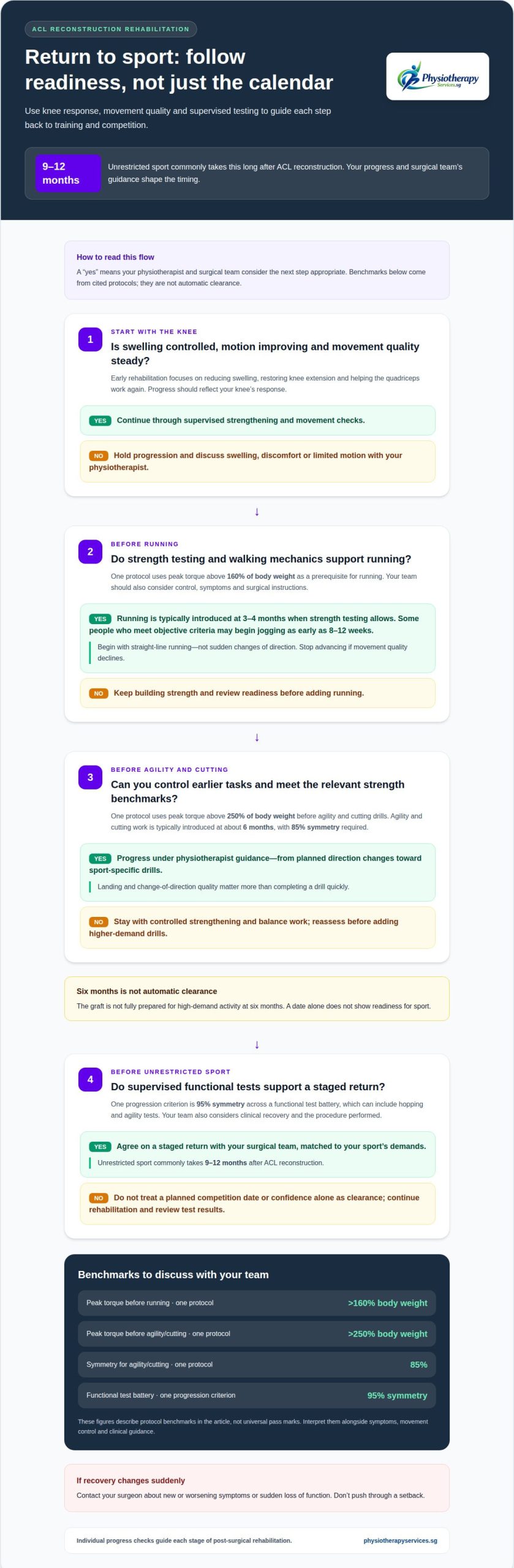
Unrestricted sport commonly takes 9 to 12 months after ACL reconstruction. Progress depends on strength, movement quality, and test results, not the calendar alone.
-
Planning Early Rehabilitation Exercises with a Physiotherapist
Ask your physiotherapist to plan exercises around your surgical instructions and current function. Early work focuses on knee range of motion and quadriceps function; later phases add progressive strengthening and balance training. Sport-specific cardiovascular fitness may enter rehabilitation during weeks 9-12. Your physiotherapist adjusts the plan when swelling, discomfort, or limited movement affects safe progress. After meniscus repair, initial knee bending may be restricted to 90 degrees.
-
Building Strength and Progressing to Running with Physiotherapy
Progress strengthening with your physiotherapist before adding running. They assess how your knee responds and whether your strength and walking mechanics support the next step. Running is typically introduced 3 to 4 months after surgery, once strength testing allows it; some patients who meet objective criteria may begin jogging as early as 8-12 weeks. Begin with straight-line running, not sudden changes of direction, and avoid advancing if movement quality declines.
-
Advancing Agility, Cutting, and Pivoting with Physiotherapy
Ask your physiotherapist to guide agility drills only after you demonstrate control during earlier tasks. Agility and cutting work is typically introduced at about 6 months, with 85% symmetry required. Your physiotherapist can progress movement from planned direction changes toward more demanding sport-specific drills. Cutting and pivoting place greater demands on the reconstructed ligament, so the quality of each landing and change of direction matters more than completing a drill quickly.
-
Testing Progress Under Professional Supervision
Use supervised progress testing to guide each stage, rather than treating a date as clearance. Unrestricted sport commonly takes 9 to 12 months, and the graft is not fully prepared for high-demand activity at six months. Additional procedures can change rehabilitation: weight bearing may be restricted for several weeks after meniscus repair or another ligament reconstruction. Contact your surgeon about new or worsening symptoms or sudden loss of function; don’t push through a setback.
Intermediate and late post-operative phases
- Use the early phase to protect the knee and establish the basics. During the first 0-2 weeks, rehabilitation focuses on reducing swelling and restoring knee extension, while helping the quadriceps muscle work again. Phase 1 is also described as roughly 0 to 8 weeks in some protocols, so follow the milestones set for your procedure rather than assuming every programme uses identical phase boundaries.
- Build endurance as you enter the intermediate phase. The intermediate post-operative phase covers weeks 7-9, while a muscular endurance development period may span weeks 7-14. Your physiotherapist can use controlled strengthening and balance activities to assess how your knee handles repeated movement. Progress when you can maintain good movement quality, not simply because a calendar date has arrived.
- Develop strength and control through the late phase. The late post-operative phase covers weeks 10-15, and a muscular strength development period spans weeks 15-21. By week 12, a functional target is knee motion from 0-135 degrees or the range of your opposite knee; another target is single-leg balance for 30 seconds with eyes open. These measures help show whether your ability is improving across activities.
- Transition between phases by reviewing motion, strength, balance, and your response to exercises. The transitional phase is listed as 4-6 months, but a protocol’s phase labels do not replace individual progress checks. If daily activities remain difficult or your knee loses motion after exercise, discuss the next step with your physiotherapist. Post-surgical rehabilitation can help structure this progression around your recovery goals.
Return-to-sport criteria
Return-to-sport decisions depend on what your knee can demonstrate under load. An ACL reconstruction rehabilitation timeline should be based on measurable readiness, not just confidence or a planned competition date.
- Review strength measurements before adding impact. One protocol uses peak torque above 160% of body weight as a prerequisite for running, and above 250% before agility and cutting drills. These figures give your rehabilitation team measurable benchmarks for different demands. They are not a substitute for assessing control, symptoms, or your surgical instructions.
-
Physiotherapy Assessment of Readiness for Running
Ask your physiotherapist to interpret strength results alongside how you load the reconstructed leg. For single-limb hop tests during weeks 20-24, one protocol targets a difference of 15% or less from the uninvolved side. A hop score is more useful when considered with landing control and knee response, rather than treated as a pass on its own.
-
Completing Return-to-Sport Testing with Professional Guidance
Complete a full functional test battery before progressing to controlled sport activity. One progression criterion is 95% symmetry across the battery, which can include tests of hopping and agility. Your physiotherapist can review whether results are consistent across tasks, while your surgeon considers the procedure and clinical recovery. An ACL reconstruction rehabilitation timeline should account for both.
- Agree on a staged return that reflects your sport’s demands. A straight-line drill, for example, does not demonstrate readiness for repeated pivots, contested play, or fatigue. Progress from controlled practice to more reactive tasks only when your movement remains coordinated. Discuss how training load, confidence, and symptoms affect the next step, and follow surgical clearance before returning to unrestricted play.
Immediate post-operative care and swelling management
- Follow the exercise instructions for your recovery room and first home sessions. ACL rehabilitation can begin on the day of surgery, with exercises introduced in the recovery room. Range-of-motion work starts immediately after the operation to help prevent loss of motion. Your surgical instructions determine which movements are appropriate, so follow them during each session rather than adding exercises on your own.
- Expect swelling to change during the first few days and share those changes with your rehabilitation team. Knee swelling commonly peaks around postoperative days 3-5. This timing can help you describe your recovery clearly, including whether swelling changes after prescribed movement or rest. Your physiotherapist can use that information when reviewing your response and planning the next stage of rehabilitation.
- Apply ice only according to the instructions in your protocol. One protocol suggests ice for 15-25 minutes during the first 2 weeks after ACL reconstruction. Keep to the recommended duration rather than extending an application because the knee still feels swollen. If your surgeon has given different instructions, follow those instructions for your operation.
- Keep a record of the guidance you receive and the exercises you complete. Note which movements were prescribed, how your knee responded, and any change in swelling afterward. Sharing these details at rehabilitation sessions gives your physiotherapist specific information to discuss instead of relying on memory. It also helps keep your exercise plan aligned with your surgical instructions.
- Use your scheduled rehabilitation reviews to clarify what comes next. Comfort and movement can change during the early post-operative period, so bring questions about exercise technique or your response to activity to each session. A physiotherapist can review your progress and help keep new exercises aligned with your recovery plan.
Singapore Physio Therapy Services | Find Physiotherapist Singapore
Singapore Physio Therapy Services | Find Physiotherapist Singapore can support your ACL recovery and help you plan a return to the activities that matter to you. Physiotherapy is tailored to your condition, lifestyle, and goals, with progress guided by your movement and function. This support can help when you need a clearer rehabilitation plan or guidance adapting your activity during recovery.
Contact Singapore Physio Therapy Services | Find Physiotherapist Singapore to discuss support for your recovery.
Plan your next step towards confident movement
Your ACL reconstruction rehabilitation timeline can also reflect what you want to return to, whether that means training with a team, moving comfortably through daily life, or rebuilding confidence in sport. Share your goals, surgical instructions, and concerns about movement with your physiotherapist. These details help shape a personalized treatment plan around your needs.
Singapore Physio Therapy Services | Find Physiotherapist Singapore has qualified physiotherapists who provide evidence-based care. Its Sports Injury Rehabilitation, Post-Surgery and Mobility Rehabilitation, and Pain Management and Physiotherapy Treatment can support different recovery needs. The team can guide your next steps with attention to your function and goals.
Contact Singapore Physio Therapy Services | Find Physiotherapist Singapore to discuss support for your recovery. A steady, individualized approach can help you keep moving towards the activities that matter to you.
Frequently Asked Questions
How long are you on crutches after ACL surgery?
Crutch use varies, but patients typically need crutches for comfort for seven to 10 days after the procedure. Many walk without crutches within 2 to 3 weeks, depending on comfort, control, and any additional surgical procedure. If your operation included meniscus repair or another ligament reconstruction, weight bearing may be restricted for several weeks, so follow the specific instructions in your surgical plan.
When can I drive?
Driving typically resumes 2 to 3 weeks after left-knee surgery, or 4 to 6 weeks after right-knee surgery or with a manual transmission. For right-knee surgery with an automatic transmission, many patients may drive after 4-6 weeks if they are off narcotic medication and have adequate reaction time. Before driving, consider whether you can control the vehicle safely in an unexpected situation.
Does the grade of the ACL tear change the recovery time?
The tear grade alone does not determine your recovery date after ACL reconstruction. Your rehabilitation plan depends on the surgical procedure and your progress in strength, movement, and everyday function. For example, an additional meniscus repair can mean different movement or weight-bearing instructions. Discuss how your procedure affects your milestones rather than using the original tear grade to predict your return to sport.
Does the type of ACL graft affect recovery time?
Graft type alone cannot tell you when you can run or return to sport. Follow the restrictions in your surgical plan and progress through functional checks with your rehabilitation team. Recovery decisions should reflect how your knee responds to strengthening and sport-related movement, alongside your surgical guidance. Ask how your procedure shapes exercise selection and which milestones will guide each progression.
How Do I Maintain My Reconstructed Knee Over My Lifetime?
Maintain knee function by keeping strength, balance, and movement practice part of your regular activity. Choose training that reflects your sport and daily demands, and increase intensity gradually when returning after a break. If your knee becomes swollen, painful, or less stable after activity, reduce the load and seek clinical advice. Continued attention to control and conditioning can support confident movement over time.
How Much Functionality Can I Regain?
In the MOON Knee ACL rehabilitation program, most patients can regain at least 90% of their original functionality. That figure describes patients in that program, not a personal prediction. Function can include walking, managing stairs, strength tasks, and sport-specific movement. Your rehabilitation team can assess these activities and identify where continued practice may help you move closer to your own goals.