
A sports injury may follow a sudden impact or develop through repeated movement and excessive load, affecting how comfortably you move, train and manage everyday tasks; returning to sport involves more than waiting for pain to fade.
Sports injury rehabilitation Singapore combines an understanding of the injury with physical therapy and gradual loading to rebuild movement, strength and readiness for activity, with a plan shaped around your condition and goals. If an injury has interrupted your routine, it’s understandable to want clear guidance, especially when you’re unsure whether to rest, modify training or begin rebuilding activity; this article explains what sports injuries involve, how physical therapy supports recovery, and how load management can guide a planned return from basic movement to sport-specific demands, while considering your confidence, training needs and how your body responds as activity builds over time.
Key Takeaways
- Recognise when an injury may need prompt medical attention, and understand how strength, movement and functional tests can help assess readiness.
- Learn how physical examination and diagnostic imaging can contribute to understanding an injury and shaping a recovery plan.
- See how gradual load changes and sport-specific practice can support a planned return to activity.
- Understand how tailored rehabilitation can address pain, mobility and strength as you work towards your activity goals.
What is a sports injury?
A sports injury affects muscles, tendons, ligaments, bones or joints during exercise. Acute injuries can follow a sudden impact or awkward movement, while repeated motion and excessive load can gradually irritate tissue. Swimmer’s shoulder, for example, is linked to repeated overhead arm movements; runner’s knee causes pain around the kneecap. Strains affect muscles or tendons, and symptoms can limit strength, movement and everyday function.
Seek prompt medical attention for severe pain, rapidly increasing swelling or spreading bruising. A joint that locks, cannot fully bend or straighten, or repeatedly gives way also needs assessment. New numbness, pins and needles, or limb weakness are warning signs. For neck pain with numbness or weakness after a collision or fall, keep the person still and call 995 in Singapore. Chest pain, severe breathlessness, dizziness or collapse during exercise also warrants emergency care.
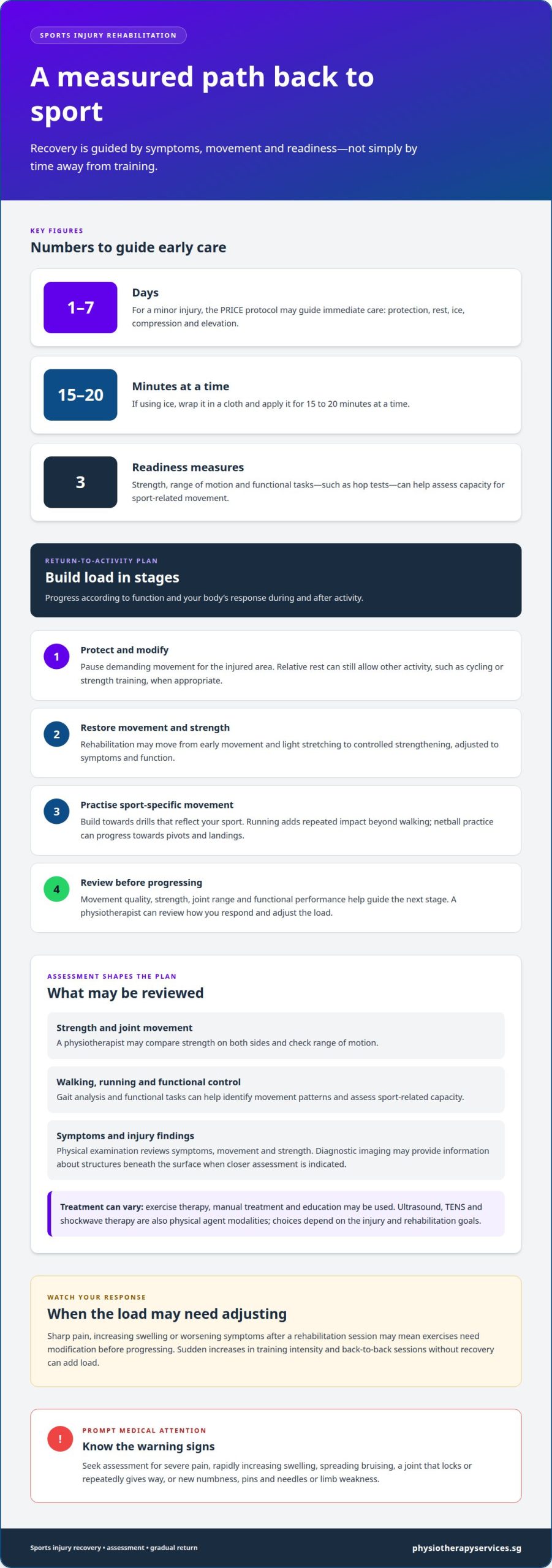
Assessment helps clarify how the injury affects movement and recovery. A physiotherapist may compare strength on both sides, check joint range of motion, and observe walking or running. Biomechanical assessment and gait analysis can identify movement patterns that may place extra stress on a joint. Functional tasks, such as hop tests, help assess control and capacity for sport-related movement. These findings guide personalised rehabilitation and help track progress.
For a minor injury, stop the activity and protect the injured area rather than training through pain. During the first 1 to 7 days, the PRICE protocol may guide immediate management: protection, rest, ice, compression and elevation. Apply ice wrapped in a cloth for 15 to 20 minutes at a time. Rehabilitation then adapts to symptoms and function, progressing from early movement towards the demands of sport.
What role does physical therapy play in injury recovery?
Physical therapy uses assessment, targeted treatment and exercise to support recovery and restore function. Sports physiotherapy focuses on movement-based care, while orthopaedic treatment addresses medical assessment and surgical options.
Physical Examination and Diagnostic Imaging
A physical examination reviews your symptoms, movement and strength, then considers how the injury affects daily tasks and sport. If the examination indicates a need for closer assessment, diagnostic imaging can provide information about structures beneath the surface. Together, these findings help clarify treatment priorities and the demands your recovery plan should address.
When to Seek Physiotherapy
Consider professional advice if pain continues beyond a few days or limits normal movement. Early assessment can help identify activities to adjust and whether a rehabilitation programme is appropriate. During recovery, sharp pain, increasing swelling or worsening symptoms after a session may mean exercises need modification. Your physiotherapist can adjust the programme in response.
Conservative Treatment and Sports Rehabilitation
Conservative treatment may combine exercise therapy, manual treatment and education. For a sprain, exercises can address stiffness and gradually rebuild strength, while guidance helps you manage activity between sessions. Ultrasound, TENS and shockwave therapy are physical agent modalities used for tissue healing and pain management. Treatment choices depend on the injury and your rehabilitation goals.
Physiotherapy and Orthopaedic Treatment
Sports physiotherapy centres on movement, exercise and function. Orthopaedic treatment involves medical evaluation and may consider surgery for severe injuries that cannot heal on their own. The approaches serve different needs: physiotherapy supports physical recovery, while orthopaedic care evaluates medical options. After surgery, rehabilitation can help rebuild movement and strength in line with recovery demands.
Load management and return-to-activity planning
Returning too early can expose an injured area to more load than it can manage. Pain or swelling may increase, making it harder to progress activity.
Relative Rest and Gradual Activity
Relative rest pauses demanding movement for the injured area while keeping other activity possible. After an ankle sprain, for example, you may maintain fitness with cycling or strength training while progressively loading the ankle under professional guidance. A physiotherapist can adjust activity to your symptoms and function, giving tissues time to adapt without stopping all movement.
Progressing to Sport-Specific Movements
Rehabilitation can progress from light stretching and controlled strengthening to drills that reflect your sport. Returning to running requires more than walking without pain: running involves repeated impact and control. For netball, practice can gradually build towards pivots and landings. A physiotherapist observes movement quality and your response before advancing to the next activity.
Criteria-Based Return to Sport
Progress depends on function, not simply time away from sport. Assessment may consider strength, range of motion and functional tasks, including hop tests. These measures help show whether the injured muscle and joint can manage sport-related demands. A clinic-based plan can increase load in stages, then review how your body responds during and after each stage.
Risks of Returning Too Early
Resuming full training before tissues adapt can aggravate symptoms and disrupt recovery. Sudden increases in training intensity or back-to-back sessions without recovery add load, while incomplete movement control may affect sport skills. If sharp pain, increasing swelling or worsening pain follows a rehabilitation session, the exercise load may need adjusting before you progress further.
What sports injury rehabilitation involves
Sports injury rehabilitation turns assessment findings into clear recovery goals. You and your physiotherapist can agree on short-term aims, such as improving joint movement, and longer-term goals, such as returning to training. Progress is monitored so exercises can change as your function improves. This connects everyday needs with the specific demands of your sport.
Exercise helps rebuild strength, endurance and flexibility. A programme may start with controlled movements, then add resistance or balance tasks as tissue adapts. For example, an isometric plank develops muscle strength without repeated joint movement. Balance practice also trains proprioception, your body’s awareness of position and movement, which an injury can disrupt.
Sports injury rehabilitation may also include hands-on joint movement or soft-tissue techniques to address stiffness and mobility. Neuromuscular re-education can add posture, balance and reaction tasks to help you practise coordinated movement. A physiotherapist can adapt exercises to changing needs and avoid excessive training demands. Activity involving uninjured limbs can help maintain fitness and coordination during recovery.
Prevention remains important as training resumes. A plan can address warm-ups, movement form, footwear and changes in workload. For a weekend runner, this might mean practising a consistent warm-up and gradually building running demands instead of abruptly adding a hard session. Regular home exercises support progress, and consistency matters more than intensity. Rehabilitation connects recovery with function, sport preparation and habits that support a considered return to activity.
During the initial stage, the general approach is rest, ice, compression and elevation (RICE).
Sports injury rehabilitation may involve a multidisciplinary team, including physiotherapists, physicians, psychologists and nutritionists. A physiotherapist may use neuromuscular electrical stimulation to improve muscle activation that a sports injury may inhibit.
Physiotherapy Services in the United States: Sports Injury Rehabilitation
Physiotherapy services in the United States provide sports injury rehabilitation for people whose pain, limited movement or reduced confidence affects training and daily activity. Physiotherapists use evidence-based treatment and personalised plans tailored to your condition, lifestyle and recovery goals. If a shoulder, knee or ankle injury affects exercise, an assessment can clarify which movements need attention and how rehabilitation can progress towards your activity goals.
Care can include targeted exercise, movement work and pain management, adapted to your needs and goals. A runner with knee pain, for example, may benefit from rehabilitation that considers strength, mobility and the demands of running, rather than focusing on symptoms alone. Your physiotherapist can monitor your response, review progress and adapt exercises as your function changes. This provides a structured way to rebuild capacity without assuming every injury follows the same path.
Consider a professional assessment if pain continues beyond a few days, limits everyday movement or returns as you resume training. If travelling to a clinic is difficult or uncomfortable, home physiotherapy in the United States brings physiotherapy to you at home. Physiotherapists also provide post-surgery and mobility rehabilitation to help rebuild movement after an operation. These options can match care to your circumstances while keeping rehabilitation focused on practical goals.
Share how the injury happened, which activities are affected and what you hope to return to. This information helps shape a plan around your priorities, whether that means comfortable daily movement, exercise or sport. Contact a physiotherapy provider in the United States to discuss your rehabilitation needs.
Frequently Asked Questions
How long does sports physiotherapy take?
The timeline depends on the injury, your progress and the activities you want to resume. A mild ankle sprain may take 1 to 3 weeks to recover with conservative treatment, while ligament injuries can require several months of rehabilitation. Your physiotherapist can review your response over time and adjust the plan, so session frequency reflects your needs rather than a fixed schedule.
Can I continue training during physiotherapy?
Often, you can continue training with adjustments that protect the injured area. Your physiotherapist can help identify suitable activities and modify movements that aggravate symptoms. For example, a session may focus on maintaining general fitness while limiting a painful sport-specific action. Tell your physiotherapist how you feel during and after training so the activity plan can respond to changes in your symptoms.
Do I need a doctor’s referral for physiotherapy in the United States?
Referral requirements for physiotherapy in the United States can vary by state and insurance plan. Some insurance policies may require a referral for claims. If you intend to submit a claim, review your insurer’s requirements before your appointment and arrange any requested paperwork. This can help you understand the steps involved in your policy’s claims process.
What should I wear to a physiotherapy session?
Wear comfortable workout clothing that lets you move freely during assessment and treatment. Choose clothes that allow easy movement of the area being assessed, such as your shoulder, knee or ankle. Comfortable attire helps your physiotherapist observe your movement and guide exercises without restrictive fabric getting in the way. You can bring the clothing you would usually wear for light exercise.
Is physiotherapy covered by insurance?
Coverage depends on your policy. In the United States, sports injury physiotherapy may be covered through employer-sponsored or individual health insurance, depending on the plan. Check your policy documents for eligibility, referral requirements and claim procedures. If you have more than one type of cover, the relevant terms for each policy determine whether and how you can submit a claim.
What Is Sports Rehab, and Why Does It Matter?
Sports injury rehabilitation is physiotherapy guided by your injury and activity goals. Returning to sport takes more than symptom relief: you also need to rebuild physical capacity for the movements your activity involves. A personalised plan can help you work towards those demands while tracking how your body responds as you resume activity.